The UK care sector is still urgently recruiting overseas professionals, but the rules around who qualifies for sponsorship have shifted significantly since July 2025.
Care worker (SOC 6135) and senior care worker (SOC 6136) were closed entirely on 22 July 2025, not just entry-level care roles, but they no longer meet the skill threshold required for a sponsored visa. Thousands of new international applicants are now facing delays and rejections simply because their job offer isn’t senior enough.
The applicants achieving consistent UK Health and Care Worker Visa Success in 2026 share one common advantage: they’ve qualified for senior care positions by completing an Ofqual-regulated Online Level 3 Diploma in Adult Care RQF , the qualification that separates sponsored professionals from rejected applicants.
This guide walks you through exactly why that qualification matters, what it costs, how the process works, and what comes after.
Why Level 3 Is the Make-or-Break Qualification for Visa Sponsorship
The most common reason care visa applications are rejected is straightforward: the role offered doesn’t meet the UK’s skilled worker threshold because the general threshold is now RQF Level 6, and Level 3 only has visa relevance for people already in the UK using transitional switching arrangements.
Understanding the skilled worker visa UK requirements is the first step. General care assistant roles classified at RQF Level 2 were largely removed from the eligible occupations list under post-2024 immigration reforms. Employers can no longer use the health and care route to sponsor those positions.
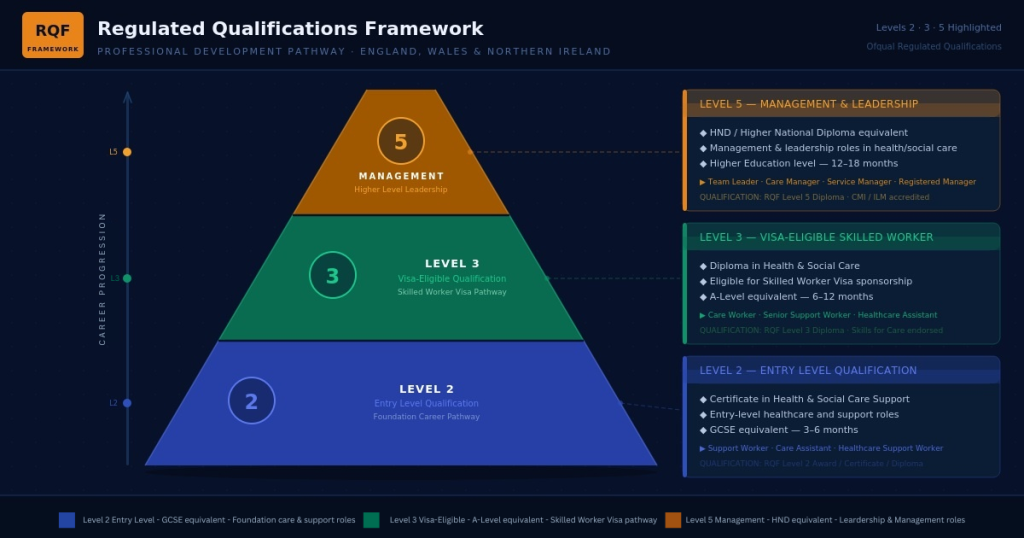
RQF Level 3, equivalent to UK A-Levels, demonstrates advanced practical knowledge, leadership competency, and regulated training in adult care. RQF Level 3 is scoped to transitional in-country switchers only.
Roles Available Through the In-Country Switching Route
Senior Care Assistant
Care Coordinator
Lead Support Worker
Team Leader in Adult Care
Completing the Senior Care Assistant Level 3 Diploma requirements positions you for all of these roles and puts you in a strong position for sponsorship in the country at a time when unqualified applicants are consistently turned away.
Financial Benefits: How the Health and Care Route Saves You Thousands
One of the most overlooked advantages of the health and care worker visa is the cost difference compared to a standard skilled worker visa. When reviewing the UK health and care visa fee , the savings become clear immediately. A family of four on the standard skilled worker route could pay over £5,000 in Immigration Health Surcharge (IHS) alone across a five-year visa period. On the Health and Care route, that figure drops to zero.
Those savings don’t disappear, they go toward accommodation, travel, and building financial stability in a new country.
For families with dependants, the IHS exemption extends across the entire household, making the Health and Care Worker visa one of the most cost-effective routes into UK employment available today.
Addressing Your Biggest Visa Concerns Directly
If you’ve read conflicting guidance online, you’re not alone. UK immigration policy changed multiple times between 2023 and 2025, leaving many applicants working from outdated information.
Staying Current with Health and Care Visa UK New Rules
Keeping up with the Health and Care visa UK new rules is essential before you apply. The post-2024 changes tightened which occupations qualify, raised minimum salary thresholds, and placed stricter checks on sponsor licence holders.
A regulated Level 3 qualification insulates you from most of these changes because it targets senior roles that have remained stable and eligible throughout all recent updates.
Checking Your Health and Care Visa UK Eligibility
Before applying, confirm your health and care visa UK eligibility against the current occupation list and your job offer. Your role, salary, and qualifications all need to align for the application to succeed.
Senior care roles backed by an RQF Level 3 qualification consistently satisfy all three criteria, which is exactly why employers prefer Level 3 candidates when issuing Certificates of Sponsorship.
The Switching Strategy for Applicants Already in the UK
Students, dependants, and temporary workers already in the UK can, in many cases switch into a sponsored healthcare role after obtaining a Level 3 Diploma and securing a qualifying job offer. But there are 2 critical omissions:
The minimum 3-month employment requirement before switching.
That new dependants cannot be added under care worker applications made since 2024.
This route has become increasingly popular for individuals who entered through other visa categories and now want a stable, long-term pathway toward settlement.
Step-by-Step Roadmap to UK Health and Care Worker Visa Success
The process is manageable when you follow a structured path. Here’s how successful applicants move from enrolment to arrival:
Enrol in an Ofqual-Regulated Level 3 Diploma in Adult Care. Choose a recognised awarding body, such as NCFE CACHE or City & Guilds. Verify Ofqual registration before committing to any provider.
Complete Clinical and Practical Modules. Most programmes include workplace assessments and competency units that directly prepare you for senior care responsibilities.
Secure a Sponsored Job Offer. Target care homes, domiciliary care providers, NHS-affiliated services, and private healthcare groups. Your employer must hold a valid sponsor licence.
Obtain Your Certificate of Sponsorship (CoS). Your employer issues this document confirming your role, salary, and sponsorship eligibility. Without it, the visa application cannot proceed.
Submit Your Visa Application Apply under the Health and Care Worker visa route with your CoS, Level 3 credentials, and supporting documents in place.
Beyond the Visa: Building a Long-Term Future in the UK
A visa is a beginning, not the destination.
After five continuous years on the Health and Care route, most workers become eligible for Indefinite Leave to Remain (ILR), effectively permanent residency. From there, the pathway to British citizenship is open.
For families, this represents genuine, lasting security. Children access UK education. Spouses can work freely. The financial pressure of annual visa renewals disappears.
Your Level 3 diploma also functions as a career launchpad beyond the visa itself:
Nursing access and allied healthcare pathways
Level 5 Leadership and Management diplomas
NHS supervisory and care management roles
Senior positions in private healthcare groups
This is why the qualification is more than a visa requirement. It’s a long-term career investment with compounding returns.
► Enrol in the Level 3 Diploma Today — Start Your UK Journey
Funding Options and Choosing the Right Training Provider
Before exploring funding for level 3 Diploma in Adult Care UK , make sure you’re enrolling with the right provider because not all care diplomas carry the same weight.
The internet is full of providers offering Level 3 Care Diplomas that are unrecognised by employers and potentially worthless for visa purposes.
Funding Pathways Worth Exploring
Employer-funded programmes from licensed UK care sponsors
Government workforce development grants (eligibility varies by location)
Flexible instalment payment plans from accredited providers
NHS-affiliated employer sponsorship schemes
What to Verify Before You Enrol
Qualifications are registered on the Ofqual Register
Awarding body is NCFE CACHE or City & Guilds
Practical assessment and workplace placement support is included
The provider has a track record placing workers with licensed sponsors
A legitimate, accredited online Level 3 Diploma in Adult Care RQF dramatically improves your prospects. An unaccredited one can cost you both the job offer and the visa application.
Your Future in UK Healthcare Starts at Level 3
The UK care sector remains one of the most accessible routes to long-term settlement for international professionals, but the route has narrowed. Understanding the current health and care visa UK eligibility criteria and positioning yourself accordingly makes all the difference.
The applicants achieving UK health and care worker visa success in 2026 are not gambling on entry-level roles. They are entering the process qualified, targeted, and prepared.
An Ofqual-regulated Level 3 Diploma in Adult Care gives you:
Eligibility for senior care roles that meet UK sponsorship criteria
Full exemption from the Immigration Health Surcharge saves thousands
A credible pathway to ILR and British citizenship
Career progression well beyond the visa itself
The decision isn’t just about a visa. It’s about where you want to be in five years.
► Enrol in the Level 3 Diploma Today — Start Your UK Journey
FAQs: UK Health and Care Worker Visa Success +
The Health and Care Worker visa is a specialist sub-route of the Skilled Worker visa built exclusively for healthcare professionals. It comes with lower application fees (£284–£551 vs £800–£1,500+), full exemption from the immigration health surcharge, and faster processing times. For care sector applicants, it is the more cost-effective and accessible route on every measure.
To qualify under either route, you generally need a valid job offer from a licensed UK sponsor, a role that meets the minimum skill and salary threshold, and proof of English language proficiency. For the Health and Care route specifically, your occupation must appear on the eligible list. Reviewing the full skilled worker visa UK requirements before applying helps you identify any gaps early.
No, a Level 3 Diploma is not sufficient. Overseas routes for SOC 6135/6136 closed 22 July 2025, and the general threshold is now RQF Level 6.
A level 3 diploma remains valuable for switching under the transitional arrangements, subject to the 3-month employment condition and the July 2028 deadline.
Yes. Depending on your employment status, location, and chosen provider, options may include employer-funded programmes, government workforce development grants, and flexible instalment plans. Some NHS -affiliated employers also offer sponsored training places. Exploring your specific options early can significantly reduce upfront costs. See our guide on funding for Level 3 Diploma in Adult Care UK for a full breakdown.
In many cases, yes. Students, dependants, and certain other visa holders already in the UK can apply to switch into a sponsored healthcare role — provided they hold the appropriate qualification and have a valid job offer from a licensed sponsor. The Level 3 Diploma makes this transition significantly more achievable.
Yes, the Immigration Salary List, which previously allowed some Level 3–5 roles to qualify under lower salary thresholds, is being phased out in December 2026. Applicants already in the UK may still access senior care roles through in-country switching under transitional arrangements, but only until 22 July 2028 and subject to meeting strict conditions.